From warships to Luxaflex®
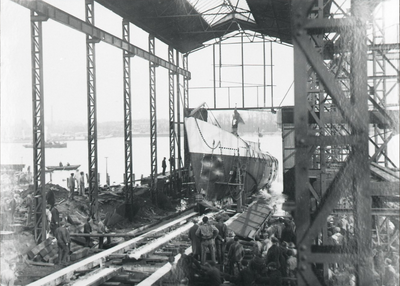
Ships were built at Feijenoord for over a hundred years: passenger ships, cargo ships, and naval vessels. That came to an end in 1929. The shipyard moved to Schiedam, but the sheds, workshops, and docks remained behind.
The site did not lie idle for long. In 1933, the German-Jewish entrepreneur Heinrich Sonnenberg came to Rotterdam, fleeing National Socialism in Germany. He established his company on Piekstraat. Where ships and steam engines had been built for years, a new era of industry began, with a completely different material: aluminum.
The start of Luxaflex®
After World War II, Sonnenberg began collaborating with the American inventor Joe Hunter. Hunter had developed a technique that allowed thin strips of aluminum to be produced quickly and in large quantities. In 1946, they founded Hunter Douglas together. From Rotterdam, the company continued to grow. And then a name appeared that almost everyone knows: Luxaflex®. In 1951, Luxaflex® was introduced in the Netherlands. That was exactly 75 years ago this year. The aluminum venetian blinds were manufactured in Rotterdam and found their way into homes and buildings both at home and abroad. Hunter Douglas grew into an international company, with the factory on the Piekstraat as part of that history.
Hunter Douglas: A Site with Numerous Functions
Shipping also continued to play a role. Ships delivered bauxite, the raw material for aluminum production. The machinery and products changed, but production was still in full swing in this part of Feijenoord. Generations of people worked at the factory on Piekstraat.
The city surrounding the site also changed. Over the course of the twentieth century, ports and industry moved further and further toward the sea, and old factory sites took on new functions. Now, the former Hunter Douglas site is also poised for such a transformation. In the coming years, homes, workspaces, and public spaces will be built here, nestled among the existing halls and quays.
It is precisely during this transition that IABR 2026 SYSTEMS OF SUPPORT will take place here. Decisions must be made about what will remain, what will disappear, and how people will eventually live and work here. What role will the existing buildings play? What does the site’s location on the Maas river mean? And how do you continue to build in a place where people have been working, creating, and starting anew for centuries?
The history of the site shows that a city never starts from a blank slate. Every new phase builds upon what already exists: buildings, land, infrastructure, knowledge, and stories.