Rotterdam south: A landscape of smoke and steel
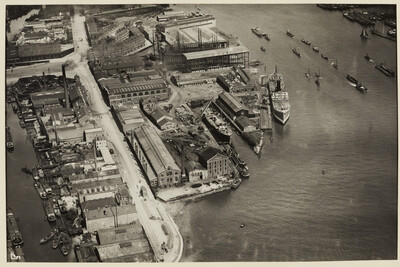
The rhythmic pounding of thousands of hammers. Steam escaping from boilers. Sparks flying from the forge. Ship horns echoing across the Maas. This is what Feijenoord sounded like more than a century ago. It must have been deafening. Around the shipyard, an entirely new part of Rotterdam began to take shape. What had once been a landscape of polders, willow groves and waterways gradually transformed into a network of docks, railways, factories and workers’ housing.
The pioneering shipyard of the Nederlandsche Stoomboot Maatschappij, featured in our previous story, did not remain simply another factory on the river. As the yard expanded, Feijenoord itself changed at remarkable speed.
The opening of the Nieuwe Waterweg in 1872 gave Rotterdam a direct connection to the sea, accelerating the growth of the port. The shipyard grew alongside it. By around 1913, it employed more than two thousand people. The site had developed into a vast industrial complex of slipways, forges, foundries, boiler shops, workshops, and engineering and drawing offices. Here, ships were built for both the merchant fleet and the navy.
Life beyond the shipyard changed just as rapidly. Workers’ housing, cafés, shops and schools appeared in its immediate surroundings. Living and working became inseparable. The factory siren marked the beginning of the working day. The Maas delivered timber, iron and coal to the yard, while the same quays dispatched ships that connected Rotterdam ever more closely to cities and ports across the world.
The history of Feijenoord is therefore about far more than shipbuilding. Around the yard emerged an intricate network of labour, transport, raw materials and trade. The Maas connected the city to international shipping routes. The shipyard created employment. Entire neighbourhoods grew alongside it.
That is what still makes this place extraordinary today. Not only because of what was built here, but because of everything that converged here.
This is precisely why the Biennale takes place here. SYSTEMS OF SUPPORT explores the systems that sustain cities. On this site, those systems have been visible for more than two centuries. Perhaps that is the most enduring lesson of Feijenoord: great cities are never shaped by a single invention or a single building, but by people who collectively create the networks that allow them to thrive.