The future of Gelderland in four design-based studies
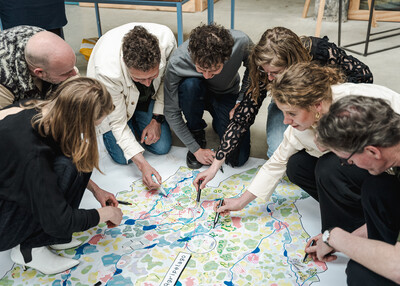
"Gelderland, and more specifically the Veluwe, holds the key to the Netherlands’ spatial future." That is what Ivar Branderhorst of Ziegler|Branderhorst suggested during the closing design session of Ministerie van Maak! x Gelderland at the Architecture Center Nijmegen (ACN). Provincial Executive Member Dirk Vreugdenhil of the Province of Gelderland received this with approval. He whispered: this is also what we are trying to make clear to The Hague.
Since September 2025, the Province of Gelderland’s Ruimtelab, the Ministry of Make! and four selected design teams have been collaborating on the question of how Gelderland can transform into a land of milk and honey.
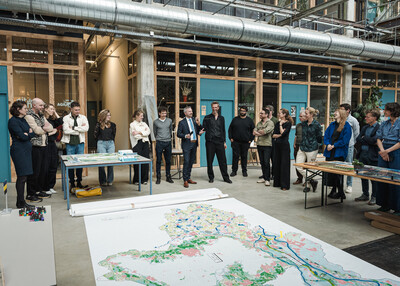
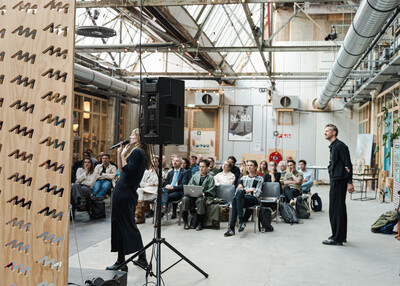
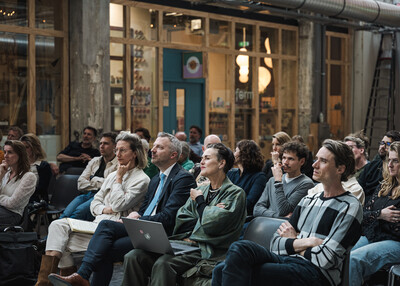
On April 16, the research and design results were presented for the first time at the NYMA makerspace, hosted by the ACN. Based on the themes of energy, water, nature, food, and housing, the teams explored various scenarios. Led by Ministerie van Maak! co-founder Kristian Koreman (ZUS), ACN Director Dave Willems opened the afternoon, under the watchful eye of Provincial Executive Member Dirk Vreugdenhil. Working together on the major spatial challenge is his motto.
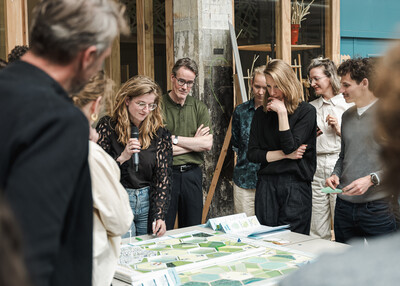
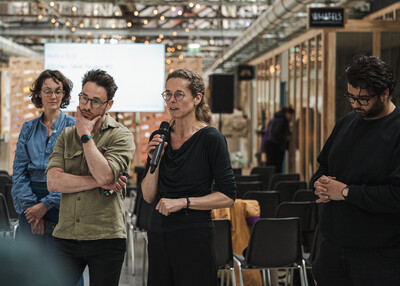
The four teams shared their research with the public in a speed-dating format. The results of the research will be on display this fall at the Provincial House in Arnhem.
YIMBA!
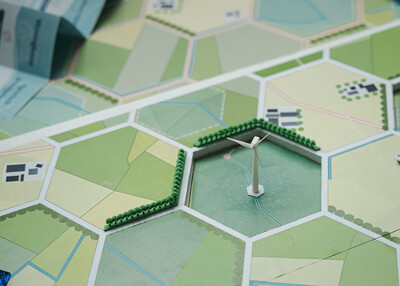
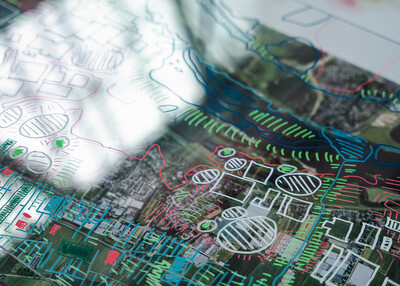
The ad-hoc design collective YIMBA! (Yes In My Back Achterhoek!) — consisting of KRAFT architects, Urban Synergy, LANDLAB, and COALstudio — employs serious gaming as a method. The central challenge in the Achterhoek region is drought and water storage. Their focus lies on the morphological potential of small depressions in the landscape — “poffertjes” — that currently remain unused. The design calls for listening, taking time, and giving farmers and citizens the space to build trust together. A collaborative game that works from different perspectives toward a shared future: not a final vision, but spatial building blocks. Land swaps, recreation, housing, and energy storage form the basis for reciprocity and policy. In this way, over the course of a hundred years, the Achterhoek can transition from a water-defense machine to a new approach to rewetting, livability, and ecology—step by step, poffertje by poffertje.
Team Ziegler|Branderhorst
The Veluwe is central to Team Ziegler|Branderhorst’s design research, centered around one question: what is nature? Since the beginning of the Common Era, this area has known all kinds of forms of cultivated nature, always in balance with people and the landscape. Only relatively recently has a complex tangle of issues such as acidification, desiccation, and fragmentation of land ownership emerged—and due to intensive food production, the area is responsible for about 20% of the Netherlands’ nitrogen emissions. Is it time to completely redesign the Veluwe?
Through an ambitious redesign plan as a nature-agriculture area—linked to defense strategies and resources—the research casts a speculative gaze on sustainable green design. Underground water flows and retention basins are given free rein; production forests are utilized for bio-based construction; and through refined densification strategies such as housing in 'ChickenCity,' Gelderland provides space for rewilding.
Team FARO & LOF
Team FARO & LOF is working in the Rivierengebied and developing a proposal for Stroomstad—perhaps the first Jetten city in the Netherlands. Building on the qualities of the Pannerdensch Canal, they combine experimental housing concepts with a new role for water. By reorganizing the water flows on the canal’s “flipper,” the eastern area becomes more resilient to drought. Where 1,200 cubic meters of water flow through per second, the landscape is fundamentally redesigned: low-lying areas for water drainage and storage, high-lying land for development. Completely energy-self-sufficient living on stilts within the landscape. The rivers serve as mobility hubs and infrastructure for hydrogen transport. In the distant future: an energy-powered Ferris wheel with functional, iconic, and recreational value. The postcard showcasing the allure of living in Stroomstad is ready to go to the printer.
Team LMNL & Dérive
Team LMNL & Dérive takes the Betuwe/Bommelerwaard region as a case study and the theme of food as a starting point. Based on cultural-historical analysis, they combine a greenhouse-residential landscape with seasonal labor—seasonal neighbors—and the restoration of landscape patterns and nature. Their research shows that since the land consolidation of 1962, a reversal has taken place: large farms with expansive land and small greenhouses have given way to a landscape dominated by large-scale greenhouses, resulting in monoculture and relatively low housing density.
The core of their design is embracing the existing landscape and empowering current growers to achieve the 2050 climate goals. Through fiscal incentives, the greenhouse landscape is transformed into a multifunctional agricultural landscape. The entrepreneurs—about seven families—can, through a new public-private partnership, organize a better balance themselves between production greenhouses, fields, water, housing, and landscape restoration: making better use of basin soils for water retention, transforming vacant greenhouses into biodiversity pockets, and softening hard transitions with a mixed-use program.