Kitchen Review: MvM! Gelderland
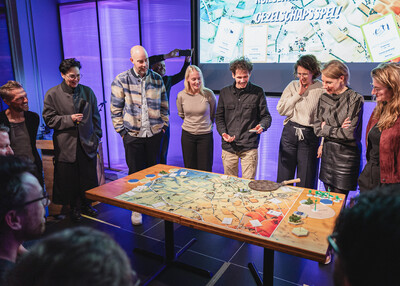
Since September 2025, the Ministry of Make! (IABR, ZUS, and MISC) and the Spatial Lab of the Province of Gelderland have joined forces. Through this collaboration, Gelderland positions itself as a province that deliberately makes room for design thinking as a driver of social innovation, with dialogue and experimentation reinforcing one another. On 4 December 2025, the interim results of the project were presented at CASA in Arnhem. Director Ton Schulte explained how the program makes research accessible to the public. The evening was marked by a dynamic atmosphere, with active contributions from the audience underscoring the project’s social relevance. Dirk Vreugdenhil, a member of the Provincial Executive, opened the meeting with a plea for research by design and for the creation of free space for dialogue, spatial experimentation, and imagination as driving forces behind social challenges.
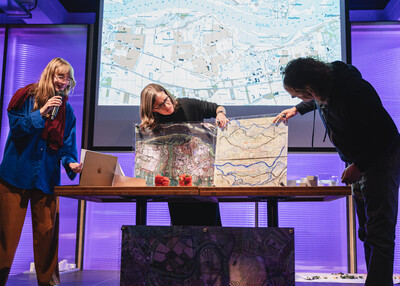
Next, during a so-called ‘kitchen review,’ the design teams offered an initial preview of how their research takes concrete form. Central to the evening was the making and presentation of results: How can the future of Gelderland be imagined, and which creative solutions and innovative lines of thinking can contribute to this? The teams were asked to bring a tangible, realized result to present at the ‘kitchen table.’
Water
Team YIMBA! (Yes In My Back Angle!), consisting of KRAFT architects, Urban Synergy, LANDLAB, and COALstudio, is working in the Achterhoek on the theme of water. The team introduced naoberschap – ‘neighborliness’ – as a carrier of shared identity, and community spirit as a binding force in the region’s transformation challenge. A poffertjespan (griddle for small pancakes) is used as a metaphor for small-scale water storage in the landscape, and a board game as a means to facilitate discussion about shared interests.
Energy
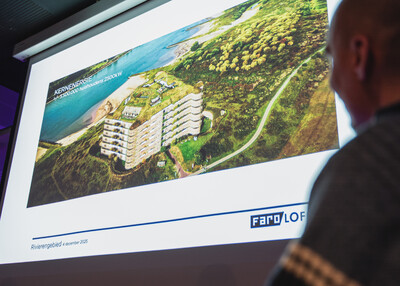
Team FARO & LOF is working in the Dutch River Region, with energy as its theme. Together, the team members are working on a far-reaching reconfiguration of the existing water system. The flipperkast, a pinball machine-shaped peninsula in the catchment area between the Waal River and the Pannerdensch Canal, could alter current river-water relationships. The team’s plan uses height differences in the landscape, varying tides, and water stored in basins as sources for energy generation.
Nature
Team ZieglerBranderhorst is working on the Veluwe region with nature as its theme and proposes a radical rebranding strategy, ChickenCity. The team’s plan draws inspiration from the area’s cultural-historical development. By introducing different zoning and planting schemes through a Natura 2050 design, the area gains vitality, biodiversity, and space for housing, while still allowing room for intensive poultry farming.
Food
Team LMNL & Dérive examines the theme of food in the Betuwe/Bommelerwaard. Following a site visit and historical analysis, the team’s research resulted in a proposal for a greenhouse-residential landscape and the restoration of landscape structures. The scale of the area and its hyper-efficient production (the ‘food machine’) primarily call for an increase in quality of life, for example through improved housing for seasonal workers.
We would like to thank all those present, and the design teams in particular, for this inspiring evening. The next two work sessions are scheduled for February and March, with experts from various thematic fields joining as well. The final results will be presented on 16 April 2026 at the Architectuur Centrum Nijmegen.