Work in the city
Rotterdamse Academie van Bouwkunst program
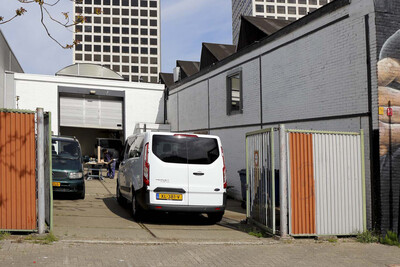
Live-work spaces and affordable commercial space are essential to the energy transition and to maintaining the quality of life in neighborhoods. Our cities are home to fewer and fewer businesses. The closure of stores and the disappearance of workshops pose a growing threat to economic diversity, social inclusion, and vibrancy. What options are there to restore balance to the city? On vision development, the construction of affordable commercial space by housing cooperatives, strengthening entrepreneur participation, and the development of new live-work concepts.
The decline in commercial space in older neighborhoods and postwar expansion districts is the result of several interrelated developments. The postwar urban planning practice of functional separation has led to a spatial separation of residential and commercial areas. As a result, the city increasingly consists of monofunctional residential neighborhoods on the one hand and monofunctional commercial areas on the other. The tight housing market also plays a role. For some time now, new housing construction has failed to keep pace with the growth in the number of households. In the fight against the housing shortage, city officials therefore favor adding housing, including in areas undergoing redevelopment. Industrial parks, in particular, are attractive for residential development due to their location, existing infrastructure, and the lack of interest in the business community among local politicians. Furthermore, real estate developers have little interest in developing commercial space. Their financial models focus on residential construction, possibly combined with office and retail space, as well as community amenities. Residential construction offers a stable return. And commercial real estate owners, in turn, support rezoning because converting their properties to residential use results in a significant increase in value. As a result, small-scale, incremental development is gradually disappearing from the city.
Admission to the event is free. Registration for this lecture is not mandatory but advisable due to limited capacity.
The language of the event is Dutch.
Program
12:00 | Walk-in
12:30 | Start lecture Cees-Jan Pen (Fontys Hogeschool)
13:30 | End of lecture
This program is a lecture of the Rotterdamse Academie van Bouwkunst.