THE TREE WILL SEE IT ALL
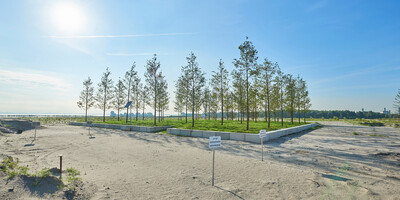
Liveable future cities need outdoor spaces, for people, for water, for nature and for trees. Trees grow slowly, but can last for a long time. What if trees would not be the final step of an urban transformation, but the start?
Today, Piekfabriek (the former Hunter Douglas site) is industrial, stony, and almost bereft of trees. Transforming it into a vibrant urban living area is quite a jump. Ground pollution will have to be taken care of, buildings have to be removed and heritage integrated.
In the first week of November a group of 25 design students from TU Munich will focus on the challenging question: what if the trees come first? They do so at the request of the Board of Government Advisors (CRa). The Board thereby contributes to, and questions, on different ways of urban transformation. A way of transforming that regards all involved parties, policies and regulations, money, the order of things, and most of all imagination. Trees are both a real value and a symbol in this. A healthy tree will easily survive all of us, but needs a lot of time to mature. Planting trees first is extremely unpractical and against all logic of urban development. Precisely that makes it in the context of the IABR a very legitimate and challenging question.
As part of this design studio, State Advisor (Rijksadviseur) and Board-member Noël van Dooren will host a public conversation. Bringing together four 'voices' to discuss different perspectives on this issue:
Hannah Schubert (B+B landscape architects) - a designer's perspective on caring for and integrating trees;
Annius Hoornstra (development advisor) - an innovative view on financial arrangements that foster alternative ways of urban development;
Christiaan Cooiman (Heijmans development) - representing the investment group that is responsible for developing the area;
Sander Claassen - on municipal policy and representing the City of Rotterdam.
The conversation aims to rethink how ‘putting trees first’ will influence development, finance and design, offering insights for both the design students and the broader public.
Drawing from the outcomes of the design studio, the CRa will work towards a publication advocating for long-standing, mature trees in our daily environment. The publication will also explore new ways of future development, given the many uncertainties we are faced with, like climate change, political instability and growing inequalities. How can trees, as long-standing structures, relate to these current uncertainties, and serve as an anchor for future inhabitants?
Admission to the event costs €12,50 (a ticket for the symposium also grants access to the exhibition).
The language of the event is English.
Program
14:30 | Walk-in
15:00 | Dialogue with Annius Hoornstra (adviseur gebiedsontwikkeling), Christiaan Cooiman (Heijmans Vastgoed), Hannah Schubert (B+B landschapsarchitecten) & Sander Claassen (Gemeente Rotterdam)
17:00 | End program