The Missing Link
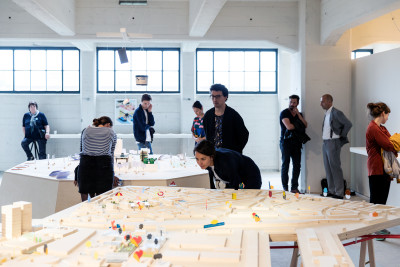
‘The Missing Link’ was an exhibition in search of that one essential, still missing link that would enable us to make the necessary transition in such an appealing and convincing way that the change would be initiated with sufficient speed. The exhibition presented the first results of the IABR–Ateliers East Flanders Core Region and Rotterdam, as well as of the Delta Atelier.
This main exhibition of the IABR in 2018 was set up as a work in progress, a demonstration of the IABR’s research practice and of the principles and research questions the designers would be working on in the coming years. The results of their research were presented at the 9th edition in 2020.
‘The Missing Link’ explored its theme in the various rooms of the HAKA Building. Central questions were: How can designers respond effectively to human-induced climate change? What is stopping us from doing so, what is the missing link? How do we make the connection between plan and project, and between project and plan?
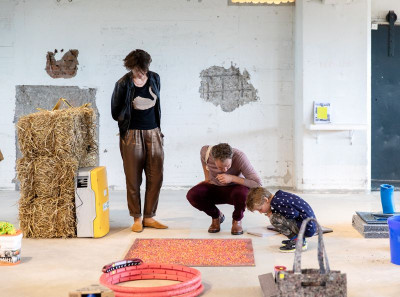
Wunderkammer
A scenography designed by Wouter Klein Velderman and Caroline Ruijgrok made it clear that we, as humanity, cannot go back in time and that the use of all modern means is necessary if we are to move in a truly sustainable direction with a rapidly growing world population. The Wunderkammer offered a kaleidoscopic overview of the impressive array of things that are already being done, in countless fields and with the commitment of many and extremely passionate people.
Turn
The third room captured the turn the curators had in mind. Human-induced climate change and its outsized claim on space are issues that affect the fate of humanity, issues that the Germans like to refer to as Schicksalsfrage. Of course, only humanity itself can intervene, but if it wants to accept its fate, accept responsibility, and make a turn, it will have to adopt a fundamentally different attitude.
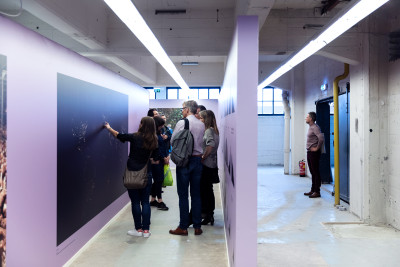
Our Future in the Delta, the Delta of the Future
In order to meaningfully explore the big, far-reaching questions in the context of the IABR, the curators decided to limit the working area for the 2018 edition to the Rhine-Meuse-Scheldt Delta, the Delta of the Low Countries. This is an area where cultural landscapes bear the deep marks of centuries of intense interaction between humanity and nature. Here we can continue to work in a tradition of change and direction.
In the final rooms, the exhibition presented the IABR–Ateliers in which work would be taking place over the next few years and whose results would be presented in the next edition of the Biennale: Atelier East Flanders Core Region, Atelier Rotterdam, and the Delta Atelier. They spent the next three years developing new practices along the lines of research proposed by the IABR and its curators: Renewable Energy Landscape, (Re)Productive City, Caring Living Environments, Healthy Agriculture, A New Mobility System, and Space for Biodiversity and Water.