Waterschool M4H+
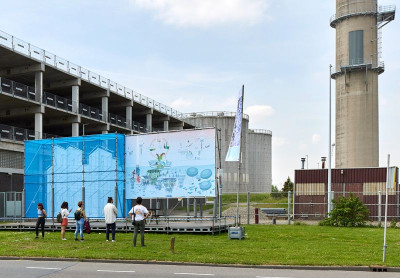
Waterschool M4H+ involved the exploration of the potential development of the Rotterdam Merwe-Vierhavens area (M4H) into a learning production landscape. The starting point is sustainable water management. In the workspace of Studio Makkink & Bey, on the western edge of Merwe-Vierhavens (M4H), the exhibition visualized what a new living and working environment could look like. The presentation included projects by various designers, artists, and architects.
The exhibition Waterschool M4H+ was part of the IABR 2020: Down to Earth. The Waterschool is a long-term research project by Studio Makkink & Bey and was previously involved in IABR 2018: The Missing Link. In the Waterschool, designers Rianne Makkink and Jurgen Bey explored ways to reduce the huge water footprint of the average Rotterdam resident. They looked not only at the water consumption of products, but also at the water consumption of the entire production process and the ecology behind it. For example, it takes 120 liters of water to make a cup of coffee.
In 2022, the Waterschool M4H+ won the Dutch Design Award in the Design Research category.
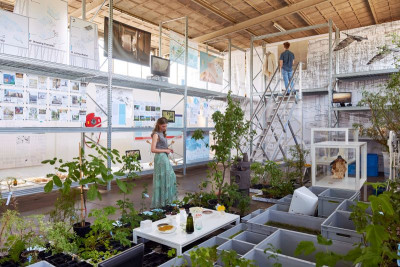
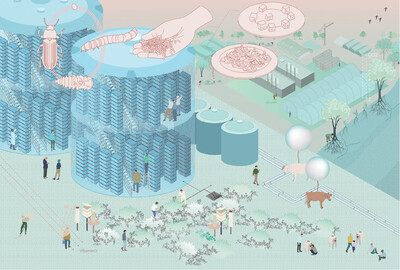
Large-scale drawings of food, material, energy, and live/work landscapes showed how the former city harbors could be (re)developed. The drawn future scenarios were mounted on the outside of the building of Studio Makkink & Bey and part of the exhibition inside. They depicted a new relationship between all living organisms, including all 6,300 future residents, in a district based on sustainable energy, food and material production, and water management.
The Waterschool explored how a range of new raw materials and resources can contribute to a sustainable society, and thus to the area’s function as a learning production landscape. For example, insects can serve as an alternative source of protein and their production requires much less water than beef, pork, or chicken. Similarly, the production of duckweed, algae, wood or fungi, potential new sources of food and materials, leaves a smaller water footprint than current food production, but requires new forms of (urban) agriculture, architecture, and energy supply. Can we perhaps extract the necessary energy from water, for example through aquathermy? And what role can the existing harbor architecture play in these new forms of urban development?
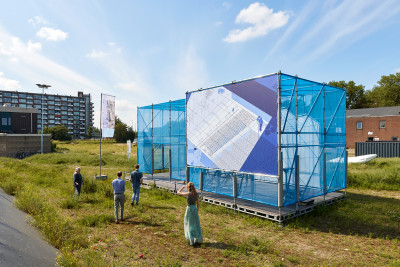
At five different outdoor locations in the M4H area, spatial installations showed how people could live and work here in the future. A QR code gave visitors access to a web application that introduced the pioneers of the area: makers, entrepreneurs, and future residents.
Each of the five installations showed the daily water consumption of an average Rotterdam resident: 119 liters per day. To provide this amount of water using rainwater, each Rotterdam resident would need an area of approximately 60 m2, with a height of 72 cm, producing 43,435 liters for an entire year.
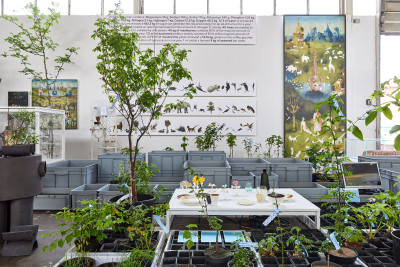
The Waterschool also showed the impact that products such as food and clothing have on everyone’s water consumption and what this means for water consumption worldwide. As a consumer, the average Rotterdam resident indirectly uses an additional 4,000 liters of water per day – 1.45 million liters per year. This means that the products we buy account for 99 percent of our water consumption. Most of this is imported, so we leave 95 percent of our water footprint abroad, and almost always in areas where water conditions are much worse than our own.
The aim of the Waterschool was to raise awareness of our huge water footprint and what we can do about it through the installations, and in workshops and debates. As more information was gathered in the area, the working exhibition evolved. As the exhibition progressed, it therefore covered all themes and findings of the research by design.