Atelier A16 Rotterdam
Mobility as a flying wheel for change
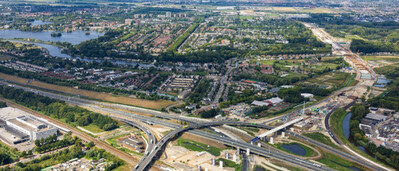
On behalf of the City of Rotterdam and in collaboration with Delft University of Technology, the Ministry of Infrastructure and Water Management, Department of Waterways and Public Works and the Independent network for metropolitan development, Atelier A16 Rotterdam: Mobility as a flying wheel for change has been launched. This new Atelier aims to use research by design to imagine the future of the A16 and its environs. The key question is how the interaction between the Rotterdam ring road, more specifically the A16, and the city of Rotterdam, with the developments on its east flank, can contribute to broader value creation, in other words, to a different view of infrastructure and environment as drivers of change.
Research by
-
Iris Wijn
Iris Wijn is an experienced urban designer with a background at the Academy of Architecture Amsterdam, where she graduated in 2013. Her graduation project was shortlisted for the Archiprix and earned her a nomination as ‘Young Innovator 2016’ with the Board of Government Advisors (CRa). Later, she worked with Steven Broekhof in Atelier NOU on various spatial studies and worked at KCAP from 2020-2024, where she focused on inner-city transformations.
As the lead designer of Atelier A16 Rotterdam: Mobility as a flying wheel for change, Iris Wijn brings valuable experience. Her research ‘Never Neverland’, on the Amsterdam ring road, is particularly relevant to her role as lead designer at the IABR. This project explored opportunities to better align the city inside and outside the Amsterdam ring road, with a focus on transforming the ring zone into an integral part of the city. Her understanding of the Amsterdam context and her ability to translate complex issues into concrete solutions make her well suited to lead the Atelier A16 Rotterdam: Mobility as a flying wheel for change on behalf of the IABR. Not only does she look at the research area around the A16 with a professional eye, but she is herself a resident of Rotterdam’s east flank, which gives her a unique perspective on the local challenges and opportunities inside the project area.
The city continues to grow as climate change and other transition issues such as water collection, livability, and biodiversity are leaving their mark on Rotterdam. The Rotterdam ring road plays a major part in the accessibility of Rotterdam, the region and the rest of the Netherlands, but also has a negative impact on our general level of wellbeing, for example in terms of barriers, emissions, noise pollution, external safety, and spatial quality. With limited space for further expansion of the physical main road network in the urban area, we are looking for innovative integrated solutions that connect the infrastructure and the environment multifunctionally rather than separate them. In other words, we are looking for ways in which the Rotterdam ring road can not only serve mobility, but also contribute to our general level of wellbeing. Inspired by successful examples such as the Antwerp ring road, Maastricht’s A2 and Groningen’s southern ring road, we are looking for solutions that fit the unique conditions of Rotterdam and the mobility system in the region.
The research by design is part of a larger project of the Knowledge and Innovation Platform on Urban Ring Roads and Spatial Development. During this research by design, the IABR will ensure an optimal and inspiring process in Atelier A16 Rotterdam: Mobility as a flying wheel for change.
Video: Noor Mastenbroek
Video: Roel van Tour
Video: Roel van Tour