Figuring Planetary Space - Abandoning Man’s Measure
Agent of Change – Patricia Reed
The International Architecture Biennale Rotterdam (financially) enables a number of researchers and has appointed them as so-called Agents of Change. These researchers are commissioned to reflect on the effects and (spatial) consequences of a changing world, by conducting research into specific themes that lie on the periphery of the current (architectural) discourse. In doing so, they deepen the understanding and/or catalyze the discussion on particular topics, which can then find their way into the public debate and contribute to sharpening, broadening, nurture and renewing the architectural discourse/discipline.
Patricia Reed is selected as Agent of Change for this research project.
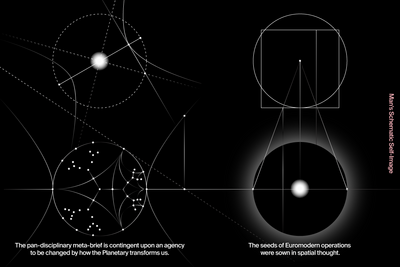
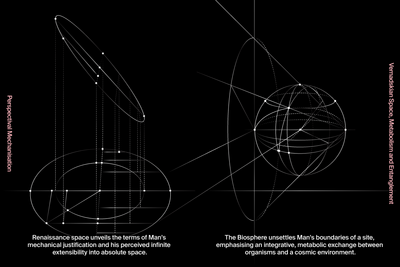
Figuring Planetary Space explores the critical role of spatial thought in the formation of historical world views, and how Planetary imaginaries unsettle centuries-long spatial conventions that persist, notably those impacting the picturing of ‘locality’ and ‘site.’ This historical and theoretical research traces the origins of Euromodernity to architectural thought in Vitruvian proportions as the symbolic index of Greco-Roman Man’s self-referentiality, culminating in the co-emergence of the invention of Renaissance perspectival space with the birth of philosophical Humanism. Framed as a pan-disciplinary meta-brief, the consequences of this self-referential invention of space (evidenced in projective linear perspective) is mapped to the burgeoning model of Man that coincides with the European colonization of the Americas. Extending the philosopher Sylvia Wynter’s account of the model of ‘Man’ as architect of our present geopolitical condition to the mediation of this self-image, the research highlights how inventions and representations of space become a technology of cognition in relating to and seeing the world in a certain way.
The discovery of the Biosphere (1926) is outlined in spatial terms as irruptive of Euromodern space, summoning a paradigmatic shift from mechanical to ecological thought, for which Man’s frames of reference are an obstacle. The research serves as a description of the stakes conditioning Planetary practice today, compelling a suspension of familiar spatial norms attuned to Man’s measure, with application in a variety of spatial pedagogies grappling with urgent questions of inhabitability beyond sustainability discourses.
Research by
-
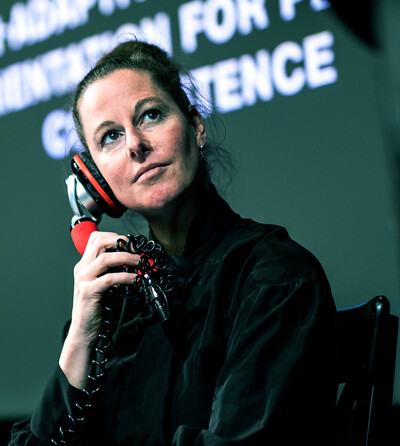
Patricia Reed
Patricia Reed is a theorist, artist and designer based in Berlin. She is Head of Critical Inquiry Lab (MA) at Design Academy Eindhoven (NL), and Lecturer at Folkwang University in Sound Practice Research (DE). Recent writings have been published in Informatics of Domination, Pierre Huyghe: Liminal, Ceremony: Burial of an Undead World, Sound - Space - Sense, The Unmanned, Navigation beyond Vision, and e-flux Journal. Reed was co-author of the Xenofeminist Manifesto as Laboria Cuboniks, since translated into more than 20 languages with a book version published by Verso. A compilation of selected essays entitled Cosmovisiones de otro mundo was released by Holobionte Ediciones (Spanish) in 2025.
Further background information about Figuring Planetary Space
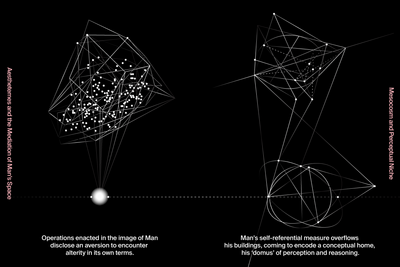
Rather than projecting thought and discourse upon the Planetary, this research asks how the Planetary refigures human self-understanding as embedded within metabolic processes. Historically, Man’s projective spatial measure manifests the image of the Globe, reinforced by aesthetic mediations attuned to this self-image as separate from nature, whereas the Planetary addresses human self-picturing as entangled within cosmic, life-sustaining processes, for which spatial articulations are nascent, at best. To this end, Figuring Planetary Space foregrounds the role of ‘mediants,’ or vehicles of mediation that enable interaction with unfamiliar, uncanonized concepts, and the role various inventions of space have played in facilitating such transformative interactions. In mingling the abstract with the existential, the history of paradigm shifts is portrayed in processual terms and not as a sequence of keyframe events, opening a space of experimentation by describing how we have arrived at different understandings of our world, and our positioning in it. By examining the function of precedent spatial mediants, playful access for practitioners working through the consequences of a Planetary Turn can be cultivated, in what can otherwise be mystified as overwhelming complexity that forecloses upon situated approaches.
What is the research method of Figuring Planetary Space?
Figuring Planetary Space developed through historical, theoretical, and philosophical research across disciplines ranging from art and architecture history, philosophy of science, evolutionary biology, World Systems Theory, and decolonial Caribbean thought. The research extends on work on the question of orientation in Planetary dimensions as a cosmological problem that examines the interplay between the external articulation of ideas as artefacts, and the internalization of them as they become naturalized into ‘common sense.’ The integration of a variety of knowledge fields echoes the epistemological underpinnings of Planetary thought, which is positioned as a historical condition, not merely a discursive topic. As a condition, the Planetary serves as a basis for shared problems across fields of thought, scales, and practice, asking how it challenges certain conventions or assumptions belonging to our various disciplines that obstruct its perceptible ramification.
What did we accomplish with Figuring Planetary Space?
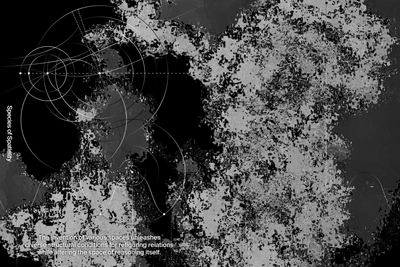
The ambition with this research was to sketch the background of the catalytic role spatial thought played in Euromodernity beyond the representation of space itself. Most critically, how it also functioned as a cognitive technology that trained a particular way to see, relate, and think the world, orienting a sense of purpose for design. Through this precedent, the urgency to internalize how the Planetary addresses us in spatial figurations becomes clear, if it is to mark a paradigmatic shift from Man’s self-understanding tethered exclusively to the Globe. In what ways do Man’s spatial measures continue to seep into our practices, obscured to us in familiarity, and through which means may we practically enable activity from without the referential frameworks of these measures?
Described as a meta-brief, this contextual research aids in communicating the stakes and parameters of educational endeavors that are entrenched in the eco-social crises of our moment without succumbing to naïve optimism, nor apocalyptic doom. It prompts a humbling, yet practical examination of the ways we relate to and externalize spatial understanding as a means of figuring entangled relationality unto itself, in a Planetary conditioning of practice that Man’s space forecloses upon. By focusing on the function of spatial mediants and how they empower narrations ‘from without Man’ across diverse scales of time and space, the tone of urgency shifts from the immobility of melancholy towards that of experimentation – experimentation premised on a suspension of perspectival coordinates that have oriented Man’s ‘bearings’ and ‘sensible clichés’ as mathematician and philosopher Gilles Châtelet put it, from whom the title of this research has been inspired.