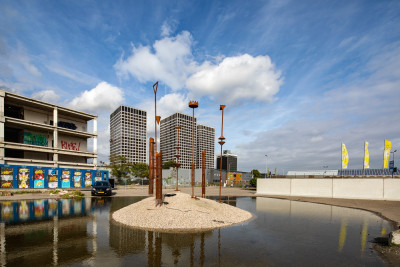
It's About Time

Fifty years after the publication of the Club of Rome report, the 10th edition of the Architecture Biennale Rotterdam is taking stock. The exhibition brings historical research (from 1972 onward), inspiring practical examples (in 2022) and future scenarios (towards 2072) together. This overview paints a picture that is both worrisome and hopeful.

The exhibition features the work of architects, urban designers, artists, academics and landscape designers that documents and maps the causes and consequences of climate change. Their observations create a contemporary landscape that reflects the effects of climate change and calls for a response to this constructed hyperreality.
Credits

Curators: Derk Loorbach, Véronique Patteeuw, Léa-Catherine Szacka and Peter Veenstra

assistent curator timeline:
Saskia Lambers

assistant curator velocities:
Theodora Gelali

assistant curators:
Maria Christopoulou, Matthew Cook, Noortje Weenink

exhibition design:
Richard Venlet with Alice Babini, Leander Venlet

graphic design:
Stahl R, Tobias Röttger, Susanne Stahl, Kathrin Baumgartner

light design:
Tim van ’t Hof with Quintus Belichting

project texts:
Lotte Haagsma, Chris Zwart

copy-editing and translations:
InOtherWords translation & editing D’Laine Camp, Maria van Tol

senior advisor:
Emiliano Gandolfi

public program:
Yonca Özbilge, Jente Diepstraten

communication, pr and marketing:
Nienke Rothuizen, Melanie Hulsebosch, Roos Rookhuizen, Sabine van der Vooren

production and planning:
Vivian Ammerlaan, Noortje Jansen, Reineke Otten, Mick van der Vooren, Tim Verhoeven, Sotirios Theologis

education:
Eef Cornelissen, Maria Kley

ticketing and volunteers:
Maaike Menheere

intern:
Feline van Bakel

sound:
Jack Bardwell

audiovisual:
WG Theatertechniek

print work:
Rocka

construction, lighting and printing:
Stijn van Aardenne, Bart Cuppens, Gido Cuppens, Jasper Droogers, Maurits Goossens, Juan Guerrero Gill, Henri Lammers, Bart Lentze, Jan Neggers, Henk Spronk

Participants:
51N4E/2001/AREP/MVRDV/University of Luxembourg, 2050+, Synthetic Cultures, ABT/Barcode Architects, Buro Mee/Quake, Cubix, AgwA, Rotor/RotorDC, Atelier Julien Boidot/Jean Souviron, BC Architects/Assemble/LUMA Arles, Benthem Crouwel Architects, Board of Government Advisors, Paul Bouet/Nicolas Dorval-Bory, Bureau Bas Smets, bureau SLA/Cornell University, Janna Bystrykh, Bêka & Lemoine, cepezed, Community Gardens Network, Delta Urbanism, TU Delft, De Urbanisten, Michael Dziwornu/Łukasz Stanek, Anastasia Eggers, Extinction Rebellion, FAST/Malkit Shoshan, Bart Feberwee, Ecem Sarıçayır/Hacer Bozkurt, Felixx Landscape Architects & Planners, Irene Feria Prados/Frieder Vogler/Rik de Brouwer, Fieldoffice Architects/ Sheng-Yuan Huang/BIAS, Architects/ Alessandro Martinelli, Flux landscape architecture, Office for Political Innovation/Andrés Jaque in samenwerking met Miguel Mesa del Castillo, Fundacion Herencia Ambiental Caribe, National Parks System of Colombia/TALLER architects, GENS, Lada Hršak/Bureau LADA/Josymar Rodriguez, Incursiones, Jo Taillieu Architecten, Kraaijvanger Architects, Kuiper Compagnons, Anupama Kundoo, Paul Landauer, Eytan Levi/Ben Hoyle, LIST/Ido Avissar, Strategic Planning General Directorate, Étienne Malapert/Agence VU’, Studio Marco Vermeulen, Mei architects and planners, MLA+, Monadnock, Davide Monteleone in samenwerking met Agence VU’, Juaniko Moreno/Nastia Volynova, MVRDV NEXT, Anne Nieuwenhuijs/Mirte van Laarhoven, noAarchitecten, Tadashi Ono in samenwerking met Agence VU’, OOZE Architects & Urbanists, Openfabric/Francesco Garofalo, ORG Permanent Modernity, Outer Space and the City, University of Toronto, Concordia University, PBL Netherlands Environmental Assessment Agency, PosadMaxwan, Chiara Pradel, Philippe Rizzotti Architecte, ETH Zürich/Pavillon de l’Arsenal, Jan Rothuizen, Massimo Siragusa in samenwerking met Agence VU’, Site Practice/Anne Geenen, SJG/Joost Grootens, Space & Matter and Common City Development, Stimuleringsfonds Creatieve Industrie, Studio Ossidiana/Embassy of the North Sea, Superuse Studios, Ian Teh in samenwerking met Agence VU’, TEN/Scott Lloyd, Inland/Tim Franco, TU Delft ABE x Wits SoAP, Turenscape/Kongjian Yu, Weronika Uyar, Joep van Lieshout, Paola Viganò, Elena Cogato Lanza, Tommaso Pietropolli, Wageningen University & Research, Water as Leverage, Richard Weller, Werkend Landschap, Site Stories/ Bright, Werkstatt, Henk Wildschut in samenwerking met Agence VU’, Charles Xelot in samenwerking met Agence VU.

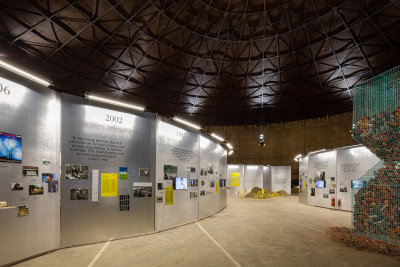
Timeline It's About Time. Photo: Jacqueline Fuijkschot

The consequences of our footprint on planet Earth are increasingly noticeable: melting ice caps, forest fires, floods and periods of drought. The situation as it is today was predicted 50 years ago by the Club of Rome, an informal group of academics, scientists, politicians, diplomats and industrialists who published The Limits to Growth in 1972. In this report, the club outlined the possible consequences of an exponential increase in population, agricultural production, resource extraction, industrial production, pollution, and the loss of biodiversity. The report caused a commotion worldwide and marked the beginning of environmental awareness.

While the Club of Rome recommended limiting growth, the 10th edition of the Architecture Biennale Rotterdam explores alternative ways of growing. The biennale is more than a wake-up call: rather than create an exclusively dark world view, it strives to show the real, hopeful possibilities of new, more radical courses toward a livable future: drastic, achievable transitions that lead to a just and ecologically sound world in which architecture and landscape design make a valuable contribution to humankind, nature, and the planetary system.
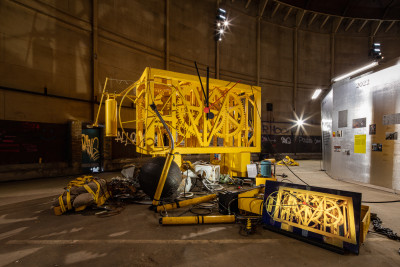
Installation by Atelier van Lieshout. Photo: Jacqueline Fuijkschot
Installation ‘The Clock That Will Solve All the Problems in the World’ by Atelier van Lieshout. Photo: Jacqueline Fuijkschot

The title IT’S ABOUT TIME hints at the ever-mounting time pressure under which we are trying to counteract the effects of climate change and connect them to other social challenges. The title also zooms in on time and speed as crucial factors in architecture and spatial design processes and appeals to the profession to work effectively to resolve socioecological urgencies.
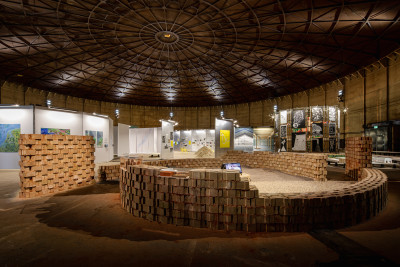
Pavilion by Anupama Kundoo. Photo: Jacqueline Fuijkschot
Ancestor Pavilion by Anupama Kundoo with the Activist Pavilion by Encore Heureux in the background. Photo: Jacqueline Fuijkschot

Three strategies: Accelerator, Activist, and Ancestor

As a starting point, the biennale formulates three strategies that designers can follow: those of the Accelerator, the Activist, and the Ancestor. The Accelerator is efficient through the use of smart technology. The Activist works together, in the here and now, with local communities on small-scale bottom-up projects that have a great deal of social support in neighborhoods and districts. The Ancestor considers the consequences that design choices made now or in the past will have for future generations. The projects and practices that the Architecture Biennale Rotterdam 2022 gathers together in the name of these three strategies are ambitious, often the result of long-term research, and widely applicable. They have been developed in close collaboration with local actors, take the spatial aspect of socioecological issues as their starting point, and use time as a tool in the design process.

The strategies each received a pavilion designed especially for the biennial: the pavilion 'Synthetic Cultures' by 2050+ represented the Accelerator, the installation 'Energies of Repair' by Encore Heureux represented the Activist and the Ancestor pavilion came from Anupama Kundoo. This last pavilion made of tamped earth was the result of a workshop "masonry with local materials" led by Studio Acte with students from the Rotterdam Academy of Architecture.
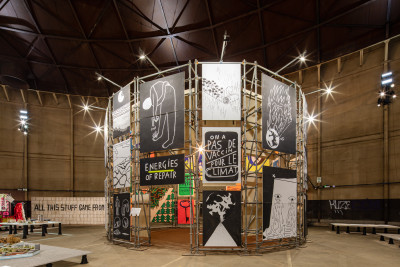
Pavilion ‘Energies of Repair’ by Encore Heureux. Photo: Jacqueline Fuijkschot
Activist pavilion ‘Energies of Repair’ by Encore Heureux. Photo: Jacqueline Fuijkschot

The exhibition was on display in the Ferro, a former gas holder in Rotterdam. The history of this location was of great symbolic value to the content, atmosphere and physical experience of the exhibition.