Key Findings from the Fifth Working Session IABR Atelier Delta Rijnmond–Drechtsteden 2100, theme Governance
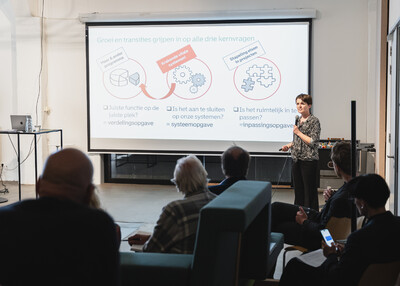
On 12 November, the fifth working session of the IABR Atelier Delta Rijnmond–Drechtsteden 2100 took place in Rotterdam. This session focused entirely on governance: how to organize collaboration, steering, and decision-making in order to enable the necessary transitions toward a climate-resilient delta. Building on insights from earlier Ateliers on the future of the port and on city and hinterland, this session continued work on recalibrating the regional water strategy, in preparation of the final presentation in January. Saskia van Stein had the role of moderator.
The design firms H+N+S and De Urbanisten opened the session with their design proposals, which respectively centered on a more open and a more closed water system. Posad Maxwan's design proposal subsequently related various long-term scenarios – shaped by factors such as global stability, economic directions, and social responsibility – to the governance question, and examined how these aspects might influence possible future images. This made visible how perspectives for 2100 directly affect choices that must already be made in the coming administrative period, and which decisions must be taken in the next five years. Saskia van Stein had the role of moderator this day.
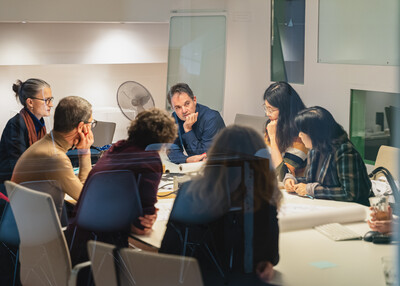
H+N+S: Working with Water (open water system)
H+N+S advocates a strategy that works with natural processes. By opening estuaries and reusing sediment flows, the delta can grow along with rising sea levels over the long term. This ‘judo approach’, however, requires institutional and cultural renewal, as well as early decisions on freshwater distribution, port access, and landscape differentiation. While the strategy is promising, its effects on flood safety and salt intrusion require further study.
De Urbanisten: Deltapolder (closed water system)
De Urbanisten presented Deltapolder, a future strategy that includes a compact, robust ring dike that encloses the delta. This strategy performs strongly in terms of flood safety, protection outside the dikes, and freshwater security. Shortened dike lines make reinforcement relatively inexpensive but require substantial investments in pumping stations and have limiting consequences for shipping. In their projection, nature loses its ecological connectivity, at the expense of biodiversity, while the Haringvliet offers new opportunities. The team also explored the spatial effects of a possible third Maasvlakte – from a retention lake to water-rich urban environments – and what these might mean to the city.
Posad Maxwan: Scenarios for an Uncertain World
Posad Maxwan outlined several possible world views in which geopolitics, the economy, and social responsibility moved in different directions. The scenario method helps test design proposals, governance choices, and investment paths under varying conditions. Their analysis shows how choices for an open or closed water system open fundamentally different future trajectories: closed systems offer more predictability and clear functional divisions between port and city but require major economic interventions and increase dependence on centralized infrastructure. Open systems, by contrast, build on social collaboration and local resilience, where nature-based solutions and spatial buffers offer opportunities, provided that the social base and spatial planning are sufficiently strong.
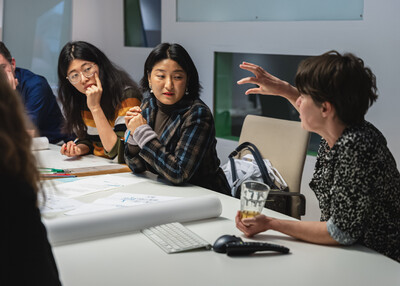
Governance experts: Robin Hill and Marije ten Kate
Following the design explorations, two governance experts gave short presentations. Marije ten Kate, Head Urban Planner for the City of Rotterdam, emphasized that vital systems (energy, water, mobility, digital) form the backbone of the delta, but that their joint vulnerability requires an integrated approach. Robin Hill of the Netherlands School of Public Administration (NSOB) showed how sea level rise is a ‘predictably surprising’ governance issue, in which ambiguity can help broaden support and embrace a new frame of ‘Living with Water’.
With the insights from this working session, a step has been taken toward completing the Atelier. In the coming weeks, the design proposals, governance pathways, and strategic choices will be further developed. The project will be presented at the end of January.