Key findings of the Final Presentation of IABR Atelier Delta Rijnmond–Drechtsteden 2100
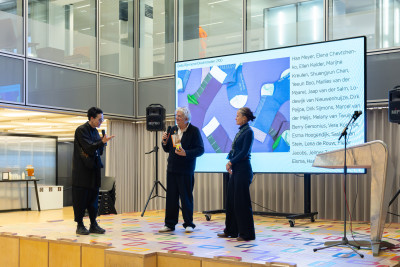
On Wednesday morning, 21 January 2026, the final presentation of the IABR Atelier Delta Rijnmond–Drechtsteden 2100 took place at the Timmerhuis in Rotterdam. During this meeting, the final results of the research by design project were presented focusing on the spatial implications of a two-meter sea level rise and a warming planet for the province of South Holland. Moderated by Saskia van Stein, attendees looked back on the outcomes of the Atelier and ahead to their significance for policy, decision-making, and public debate.
The value of research by design
In her opening remarks, Saskia van Stein underscored the strength of research by design as the driving force of the Atelier: an open, investigative approach that brings different forms of knowledge together. Collaboration generates new knowledge and, through the cross-fertilization of research, experimentation, and dialogue, the mutual understanding emerges that is needed to navigate towards an uncertain future together.
Dirk Sijmons emphasized this by describing research by design as a ‘third way’: neither fundamental research nor direct policy implementation, but rather a craft of exploring, testing, and visualizing. This approach creates space to surface new relationships, particularly in relation to issues such as sea level rise and system transitions. In this context, he introduced the concept of nature-based engineering as ‘advanced civil engineering’ and put the required investments into perspective: for flood safety, this amounts to approximately €25 billion for the period 2025–2100, according to estimates by HKV Consultants. This is roughly 10 to 12 times the investment in the Room for the River program (€2.3 billion) and about four to five times the budget of the Oosterschelde Works (€6 billion in 2025).
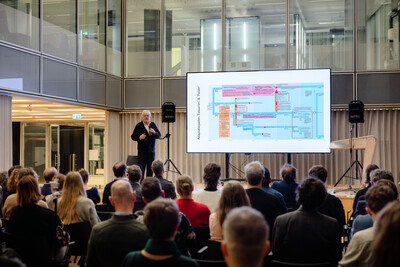
"This approach creates space to surface new relationships, particularly in relation to issues such as sea level rise and system transitions."
Dirk Sijmons
Two strategic cornerstones for the delta
The discussion centered on two future strategies: an open water system and a closed water system.
H+N+S - Growing with water
Jasper van Hugtenburg explained the open strategy, in which natural processes take precedence. Rather than viewing sediment as a problem, it is understood as a resource that allows land to grow in step with rising sea levels. Examples included the Land van Saeftinge, at four meters above NAP, and the double dikes in Groningen. Rivers can function as tidal parks, while areas outside the dikes require tailored solutions combining adaptation, quays, and storm surge barriers. At the same time, this approach demands clear choices in time and space, for example regarding the accessibility and transformation of the Botlek area and the role of the port in the transition from a fossil-based to a sustainable manufacturing industry. Further knowledge development – regarding, for example, sedimentation processes and permeable storm surge barriers – remains necessary.
De Urbanisten - The Deltapolder
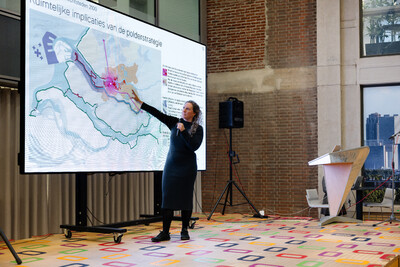
Dirk van Peijpe presented the closed strategy of the Deltapolder: a single, strong ring dike along the southern edge of the Randstad, with regulated water levels and a clear separation between the sea and the delta. While this approach offers high water safety and predictability for urbanization and freshwater supply, it has major consequences for shipping and nature. Tidal dynamics would shift toward freshwater ecosystems, and deep-sea shipping would be concentrated in the west. At the same time, new opportunities would emerge, including a brackish Haringvliet, the transformation of the Botlek area, and the potential for an ‘energy-basin’ retention lake on a third Maasvlakte.
During the discussion, it became clear that both strategies are feasible, come with different cost profiles, but could potentially coexist or be extended into one another. The key lies in regional-scale choices with implications for housing, the economy, nature, and governance. The attendees also explored a phased approach.
Posad Maxwan - Worldviews and adaptation pathways
Elena Chevtchenko placed both strategies in the context of different worldviews and the future role of the port. Alongside the macroeconomic perspective, she also addressed ecological and sociocultural aspects. Her analysis showed that uncertainty and complexity are not exceptions but rather the starting point for the long-term. The scenario method helps reveal dependencies, tipping points, and ‘no-regrets’ measures, thereby strengthening the basis for policy decisions.
Reflection and closing of Atelier Delta Rijnmond-Drechtsteden 2100
Hermen Borst (Director of Urban Development for the City of Rotterdam), Pieter Jacobs (Program Manager for the Delta Program Rijnmond–Drechtsteden at Rijkswaterstaat), Berry Gersonius (Strategic Advisor on Climate and Flood Safety for the City of Dordrecht), and IABR lead designers Jelmer Teunissen and Dirk Sijmons all emphasized the importance of continued research by design. They described it as an indispensable approach for identifying connections between scales, sectors, and timelines, and for clarifying complex challenges that are not yet fully understood. Design not only supports the exploration of solutions but unveils visible points of tension and choices at stake, and the responsibilities they entail.
In this context, solidarity was identified as a core value in the distribution and discharge of water, as well as in the management of space, risks, and investments in the delta. Several speakers emphasized that not choosing is a choice in itself: postponing decisions and maintaining the status quo are also choices, with far-reaching consequences for future generations.
The spoken-word performance by Moze Naél provided a strong conclusion to the morning. In a personal and imaginative contribution, he connected living with water, change, and responsibility to human experience. He added an emotional and experiential dimension to a debate that is often conducted in technical and spatial terms.
This Atelier did not produce definitive answers but clarified what can be imagined and opened the conversation about the future of the delta. The outcomes form a building block for recalibrating the Delta Program and for the continuation of public and administrative debate on how we in the Netherlands want to live with water, now and over the coming hundred years.
The results will be published online in a digital publication